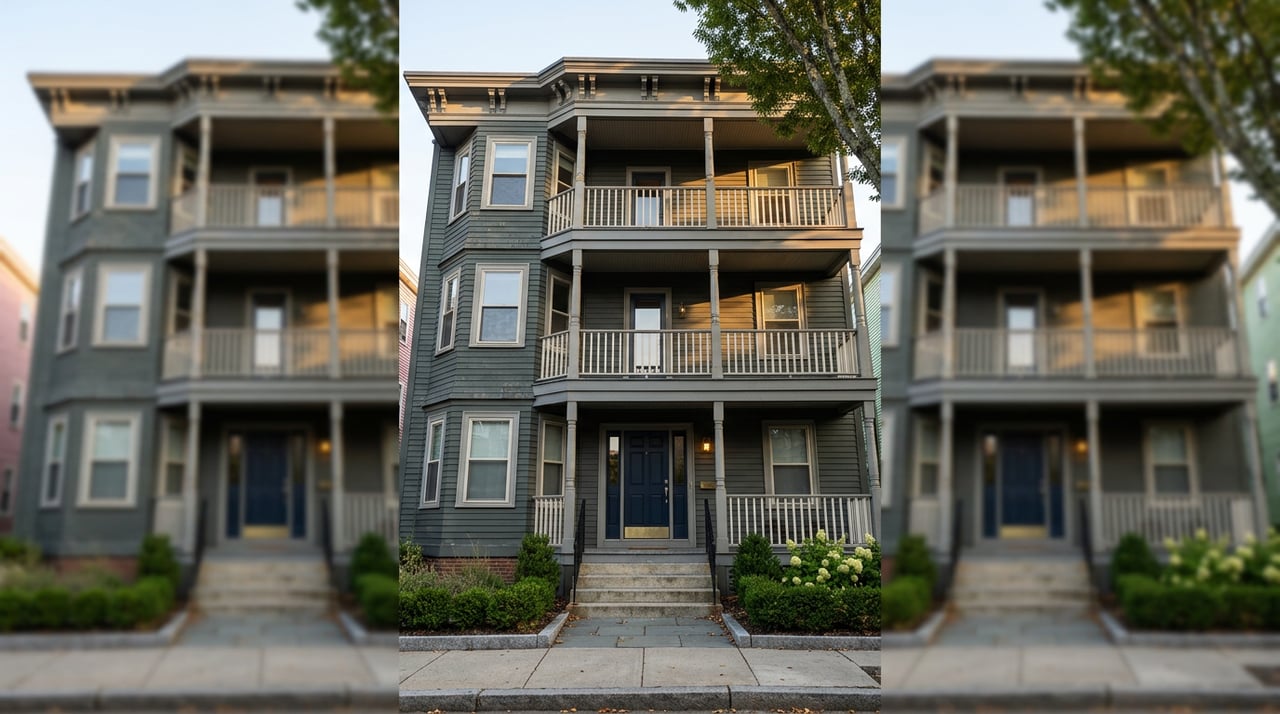
Malden's Multi-Family Sellers Are Racing a Clock Nobody Told Them About
September 17, 2026
September 17, 2026
A seller with an accepted offer on a two-family near Maplewood Square calls the Malden Fire Department the week after going under agreement. The buyer's rate lock closes in eighteen days. The fire prevention clerk explains the inspection calendar: Tuesdays and Thursdays only, multi-family units seen between one and three in the afternoon, and the next opening isn't until the following Thursday. If the property fails on the first visit, there's no guarantee of a second slot before the lock expires.
This is not a hypothetical. It's how Malden's smoke and carbon monoxide certificate process actually works, and it catches multi-family sellers off guard more often than single-family sellers because the process is structurally slower for buildings with more than one unit.
Massachusetts law requires every home sale to come with a certificate of compliance showing the property's smoke and carbon monoxide alarms meet code. The Massachusetts Department of Fire Services is clear that this certificate has to be in hand before a closing can happen. No certificate, no closing, regardless of what the purchase and sale agreement says.
What most sellers don't expect is that Malden runs this as a two-visit system, not one. The Malden Fire Department offers an optional pre-inspection layout, where fire prevention staff walk the property, identify exactly where detectors need to go based on the building's age, and flag anything that will fail before the real inspection happens. That layout costs half of what the full inspection costs. For a one-family home, that's a $25 layout and a $50 inspection. For a two-family, it's $50 for the layout and $100 for the inspection. Larger multi-family buildings are quoted directly by the fire prevention clerk, since the fee and the scope both scale with unit count.
Skipping the layout doesn't skip the requirement. It just means the first time anyone from the fire department sees your detectors is the day of the real inspection, and if something's wrong, you're back on the schedule for a second Tuesday or Thursday.
Malden's inspection calendar splits the week by property type. One- and two-family homes are seen Tuesday and Thursday mornings, nine to eleven. Multi-family properties get the same two days, but only the one-to-three afternoon block.
That's a two-hour window, twice a week, to cover every duplex, triple-decker, and small apartment building in the city that's changing hands. A single-family seller who fails an inspection on a Tuesday morning has a shot at squeezing back in Thursday morning. A three-family seller with the same problem is competing for that same narrow afternoon slot with every other multi-family closing in Malden that week.
Multi-family properties also take longer to actually inspect. Three units mean three sets of detectors to check, sometimes three different tenants to coordinate access around, and often three different renovation histories if units were updated on different timelines. The building doesn't get more time on the calendar. It just has more that can go wrong in the time it has.
| 1-Family | 2-Family | 3+ Family | |
|---|---|---|---|
| Layout fee | $25 | $50 | Quoted by Fire Prevention Bureau |
| Inspection fee | $50 | $100 | Quoted by Fire Prevention Bureau |
| Inspection days | Tue / Thu | Tue / Thu | Tue / Thu |
| Inspection window | 9 to 11 AM | 9 to 11 AM | 1 to 3 PM |
The requirement itself comes from Massachusetts General Law chapter 148, section 26F, which mandates approved smoke alarms at the point of sale or transfer, with a companion provision covering carbon monoxide alarms. Exactly which detectors you need, and where they go, depends on when the building was constructed or last permitted for renovation. A triple-decker built before 1975 has different placement rules than one that went through a gut renovation in the 2000s. This is precisely why the pre-inspection layout exists. It tells you which set of rules applies to your specific building before you're standing in front of an inspector on the day of the real appointment.
The certificate itself doesn't last indefinitely. Most Massachusetts fire departments treat it as good for a matter of weeks after issuance, not months, so sellers who get the certificate too early in a slow-moving deal can find it's expired by the time they actually reach the closing table. The original document, not a copy, is what the closing attorney needs in hand.
None of this would be worth writing about if Malden's multi-family market moved slowly enough to absorb a scheduling delay without consequence. It doesn't. Multiple listing sources tracking the city this year show roughly two dozen multi-family properties on the market at any given time, with asking prices clustered near $930,000, and homes across Malden generally selling in well under a month, often in the low-to-mid twenties for days on market through mid-2026.
That pace cuts both ways for sellers. A fast market means strong offers and less time sitting on the market. It also means the contractual timeline from accepted offer to closing is often tight enough that a fire department appointment scheduled a week too late becomes the reason a closing slips, not the buyer's financing or the title work. In a market where deals move in three to four weeks, a two-day-a-week inspection calendar with a two-hour afternoon window for multi-family properties isn't a minor scheduling detail. It's one of the few parts of the transaction timeline that a seller can actually control if they start early enough.
The practical fix is straightforward. Call the Malden Fire Prevention Bureau and request the pre-inspection layout as soon as you decide to list, not after you accept an offer. Confirm the year your building was built or last permitted, since that determines which detector rules apply. If your property has had different renovation dates on different floors, mention that when you schedule, since it can change what's required unit by unit.
Sellers working with tenants in place should also build in time for access coordination. Massachusetts requires advance written notice before showings and inspections, and getting three units aligned for the same afternoon appointment takes more lead time than a single-family seller needs for one household.
None of this is a reason to avoid selling a multi-family property in Malden. It's a reason to treat the smoke certificate as a task for week one of your listing timeline, not a box to check after you're already under agreement.
Does a certificate from a previous sale still count? No. The certificate is tied to the specific transaction. A prior sale's certificate, even a recent one, does not carry over to a new sale.
What if a tenant won't allow access for the inspection? Massachusetts requires landlords to give tenants advance written notice before entering for inspections, but the underlying compliance requirement doesn't go away. Building in extra lead time for tenant-occupied units is the practical solution most sellers use.
Does a five-plus unit building follow the same process? The core smoke and CO certificate requirement still applies, but fees and scheduling for larger multi-family buildings are handled directly by the Fire Prevention Bureau rather than the standard published rate card, so it's worth calling ahead to confirm specifics for your property.
If you're weighing the sale of a two- or three-family property in Malden and want a transaction timeline built around the parts of the process that actually move slowly, Guy Contaldi has spent years managing exactly this kind of multi-family closing across Greater Boston. Reach out for a consultation before you list, not after you're already counting down to a closing date.
Stay up to date on the latest real estate trends.



Whether buying, selling, or investing, I’m ready to put my decades of experience and client-first approach to work for you. Contact me today to get started with a trusted Boston real estate expert.